August 20th marks the feast day of St. Bernard of Menthon, the Italian monk and namesake of those teddy bear-like “barrel dogs.”
Rescuer of the Swiss Alps and star of the hit Beethoven movies, the Saint Bernard is one of the most iconic and well-loved dogs in human history. With those warm, deep-set eyes, those oversized paws, and that cuddly, fluffy coat, it’s easy to fall in love with a Saint.
In honor of St. Bernard’s Day, learn how the Saint Bernard breed has been a devoted companion for generations and what you should know if you’re hoping to adopt a sweet Saint into your family.
How the Saint Bernard Came To Be
The Saint Bernard breed originated in the Saint Bernard Pass, a treacherous passageway through the Swiss Alps that travelers took between Switzerland and Italy. A hospice and monastery, founded by canonized Italian monk Bernard de Menthon, served as a refuge for weary travelers.
From the early 1600s, ancestors of the modern Saint Bernard breed served as companions, rescuers, and working dogs for the monks and hospice guests. The dogs were most famous for using their powerful sense of smell to locate those stranded along the Saint Bernard Pass.
With their large, strong physique and dense coat, the dogs were well equipped to dig through snowdrifts and rescue travelers trapped in avalanches. The dogs were also known to stay with stranded travelers until help arrived, if needed. There are a few painted depictions of the dogs carrying barrels of whisky or brandy on their collars, though according to the monks, this practice was not commonplace.
The original Saint Bernard dogs had a short, dense coat. The monks cross-bred the dog with a long-haired breed — possibly the Leonberger or Newfoundland — in hopes of creating a longer coat that would help keep the dogs warm in below-freezing temperatures. However, snow would quickly pack onto the dogs’ long fur and weigh them down. The short-coated Saint Bernard proved to be best for rescue work, while long-coated dogs were sent to the alpine valleys to work on farms.
The dogs of the Saint Bernard hospice saved approximately 2,000 lives across two centuries. The most famous of the dogs, named Barry, is said to have rescued at least 40 travelers.
Saint Bernard Breed Traits
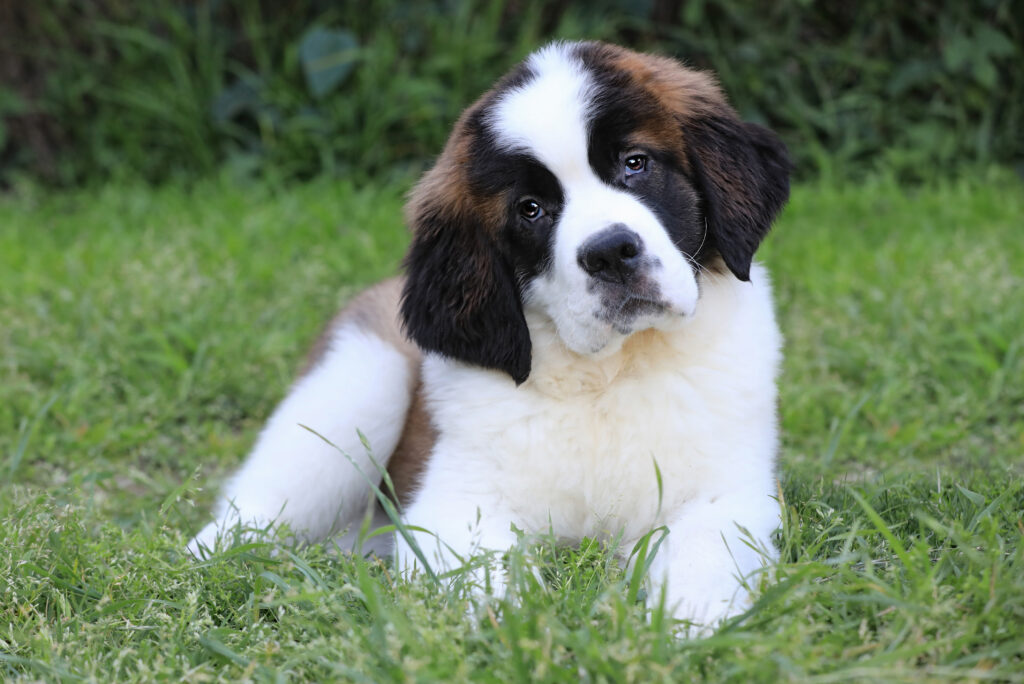
The Saint Bernard is a large, muscular breed, with males standing up to three feet at the shoulder. They can weigh between 120 and 180 pounds. Most don the classic white-and-brown or white-and-red coat with a black mask, though a brindle-and-white variation is also accepted in the American Kennel Club (AKC) breed standard. While short-coated Saints are most common, long-coated dogs are also accepted and often appear in litters.
Common Health Issues in Saint Bernards
The Saint Bernard is relatively healthy, but like other giant breeds, it has a short average lifespan of just eight to nine years. Owners should be aware of the following conditions.
Eye Conditions
The Saint Bernard’s droopy eyelids are one of their most charming traits, though they do leave the breed more susceptible to eye conditions. Many dogs have either — or a combination of — an entropion (inward-turning) and ectropion (outward-turning) eyelid, which can lead to irritation and a predisposition to infection. Surgery is sometimes needed to correct these issues.
Bloat
Like other deep-chested breeds, the Saint Bernard is susceptible to a life-threatening condition called bloat, in which the stomach twists and fills with gas. If left untreated, the condition can become fatal in a matter of hours. To keep the stomach from twisting, veterinarians often recommend gastropexy, a preventative procedure in which the stomach is sutured to the abdominal wall, often performed when the dog is spayed or neutered.
Degenerative Cardiomyopathy
Degenerative cardiomyopathy (DCM) affects about 2.6 percent of Saint Bernards according to the Purdue Veterinary Medical Database. This genetic condition causes the heart to become enlarged and can cause fatal heart failure.
Hip and Joint Dysplasia
Like many large breeds, Saint Bernards are prone to hip and joint issues. Responsible breeders have their breeding stock tested for hip and joint dysplasia to reduce the risk of passing these conditions on to offspring.
How To Care for Your Saint Bernard
Nutrition
The Saint Bernard puppy’s first year of life is one of rapid growth, which should be managed with a large-breed puppy food. Growing too quickly — which can occur in puppies fed regular puppy food or those that are overfed — can lead to lifelong musculoskeletal issues.
Drool Management
Saint Bernards tend to drool. You can keep your dog clean and dry by keeping a drool rag at the ready. A drool bib, placed around the dog’s neck, can help catch dribbles.
Grooming
Both long- and short-haired Saint Bernards have a double coat that sheds during the spring and fall shedding seasons. Daily brushing can help reduce fur blown around your house and furniture. Keeping your dog’s skin and coat healthy starts with a consistent grooming routine.
Why We Love Saint Bernards
Though it has been centuries since the Saint Bernard was on rescue duty in the Swiss Alps, their loyal descendants have continued to be devoted companions for their human family members. Known as a gentle giant, the breed is known to get along well with children and other pets. Saint Bernards are also highly intelligent, responding well to training when initiated at an early age to control jumping, food stealing, and other undesirable behaviors.
Thinking about adding a Saint Bernard to your family? Look for a reputable breeder registered with the AKC and the Saint Bernard Club of America. A responsible breeder has their breeding stock tested for inherited issues like hip and joint dysplasia and eyelid conditions, striving to produce healthy puppies with a stable temperament. Breed-specific rescues, too, can be a great resource for finding a well-bred Saint Bernard that is healthy, trainable, and as loyal to their humans as their ancestors that rescued travelers in the Swiss Alps.
Every pet deserves to live a long, happy, healthy life.